
Most people view their bank accounts as static reservoirs—containers where money sits until a bill requires its departure. This passive approach creates a significant drag on your long-term wealth building. In macroeconomics, the velocity of money measures how many times a single unit of currency circulates through the economy to buy goods and services within a given timeframe. When applied to your personal finances, money velocity represents how quickly and efficiently your dollars move from your paycheck into productive assets, debt repayment, or high-yield savings.
Stagnant money is expensive. When your cash lingers in a standard checking account earning 0.01% interest while inflation fluctuates between 3% and 4%, your purchasing power actively evaporates. To master cash flow management, you must transform your financial structure from a series of disconnected puddles into a high-speed transit system. Every day a dollar sits idle is a day it fails to work for you; conversely, moving money too quickly into illiquid investments can leave you vulnerable to high-interest debt during an emergency.

– Describe visible? Yes (coin, ice, energy swirls).
– Engaging/Relevant? Yes.
– No quotes/attribution? Yes.
The Hidden Drag of “Lazy Money”
Lazy money refers to cash that stays in low-interest environments longer than necessary. According to the Federal Deposit Insurance Corporation (FDIC), the national average interest rate for savings accounts as of early 2024 hovered around 0.47%, yet many “Big Bank” checking accounts still offer a dismal 0.01%. If you keep $10,000 in a traditional checking account for a year, you earn $1. Moving that same $10,000 into a High-Yield Savings Account (HYSA) or a Money Market Account earning 4.50% nets you $450.
The velocity of money in your personal life isn’t about spending faster; it is about reducing the “dwell time” in non-productive accounts. Think of your primary checking account as a distribution hub—a transit station where money arrives via direct deposit and departs within 24 to 72 hours toward its final destination. Whether that destination is a brokerage account, a Roth IRA, or a high-interest credit card balance, the goal is to keep the momentum high.
“The velocity of money is what creates wealth. If you have a dollar and you use it to buy a widget, and then you sell that widget for two dollars, and you do that every day, you are going to be a lot richer than the guy who buys a widget and waits a year to sell it.” — Robert Kiyosaki, Author of Rich Dad Poor Dad

The Three Speeds of Personal Finance
Effective efficient banking requires categorizing your cash flow into three distinct speeds. Each speed serves a specific purpose, and the secret to wealth building lies in balancing these movements without creating a liquidity crisis.
- High Velocity (The Flow): This is your income. It should enter your ecosystem and be redirected immediately. Automation is the engine here. Your mortgage, utilities, and investment contributions should trigger as soon as the funds clear.
- Medium Velocity (The Reservoir): This includes your emergency fund and short-term savings (vacations, home repairs). This money moves slower because its primary job is stability, not growth. However, it should still live in a vehicle like an HYSA to maintain purchasing power.
- Low Velocity (The Foundation): These are your long-term investments—401(k)s, IRAs, and taxable brokerage accounts. Once money enters these accounts, its velocity should drop to near zero. You want this money to “sit and bake” for decades to take advantage of compound interest.
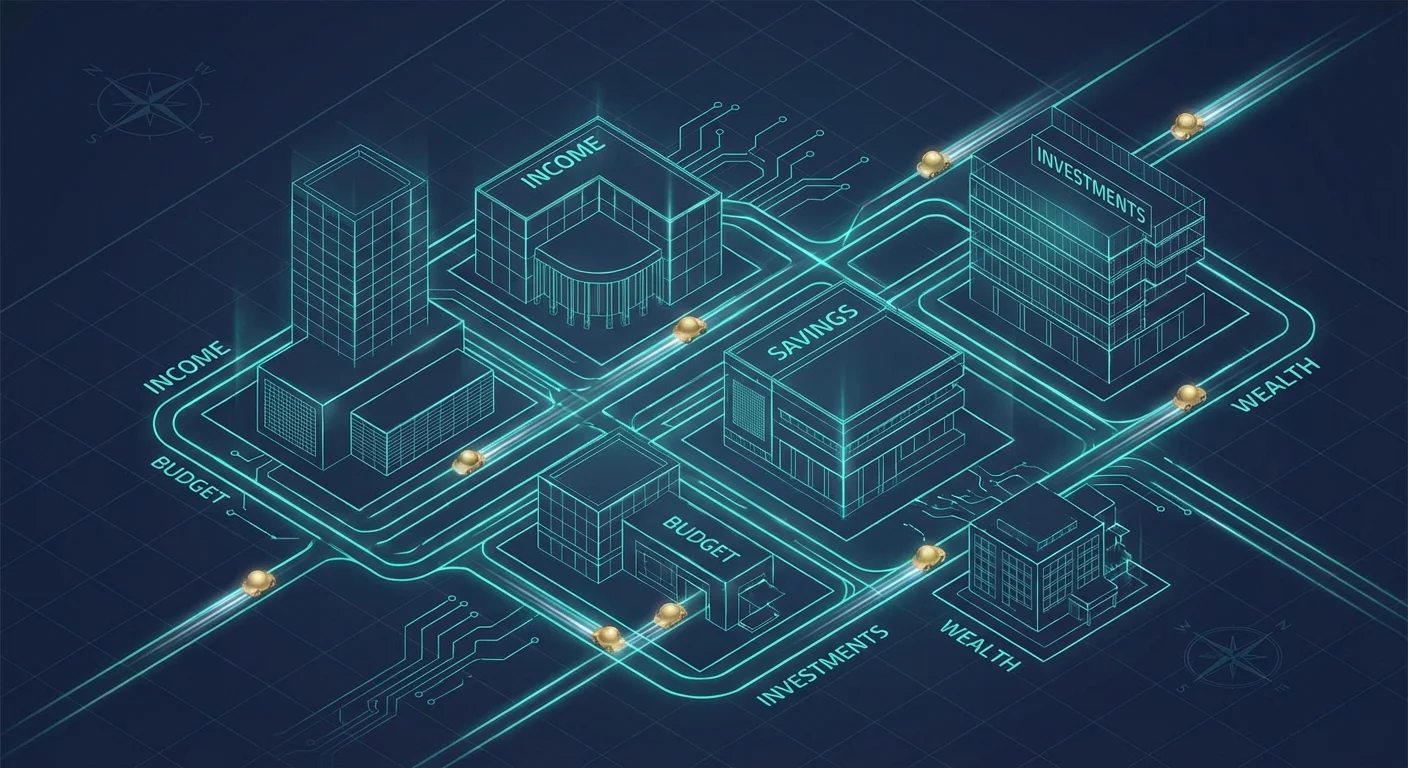
Constructing Your Financial Transit Map
To increase your money velocity, you need a clear map of where every dollar goes the moment it hits your account. This is the essence of cash flow management. If you are manually moving money every month, you are creating friction. Friction slows velocity. By the time you remember to log into your portal to transfer $500 to your savings, you might have already spent $100 of it on an impulse purchase.
Consider the following flow as a blueprint for a high-velocity system:
- Direct Deposit: Direct your entire paycheck into a central checking account.
- Immediate Sweeps: Set up an automatic transfer for the day after payday to move a fixed percentage into your HYSA (Emergency Fund).
- Investment Triggers: Schedule your IRA or brokerage contributions for 48 hours after payday.
- Bill Pay: Use automated bill pay for fixed expenses (rent/mortgage, insurance, internet).
- The Remainder: Whatever stays in the checking account is your “guilt-free” spending money until the next cycle.
This system ensures that your most important financial goals are funded before you have the chance to intervene or hesitate. You can find detailed resources on setting up these types of automated systems through the Consumer Financial Protection Bureau (CFPB), which offers guides on managing your banking relationships effectively.

Comparing Account Dwell Times
How long should a dollar stay in any given account? The table below outlines the optimal “dwell time” to maximize efficiency while maintaining safety.
| Account Type | Purpose | Optimal Dwell Time | Target Velocity |
|---|---|---|---|
| Standard Checking | Operational hub, bill paying | 1–7 days | Very High |
| High-Yield Savings | Emergency fund, major purchases | 3–12 months | Medium |
| 401(k) / IRA | Retirement, long-term growth | 10–40 years | Very Low |
| Brokerage Account | Wealth building, medium-term goals | 5–15 years | Low |
| Credit Card | Transactional efficiency | 30 days (must pay in full) | High |
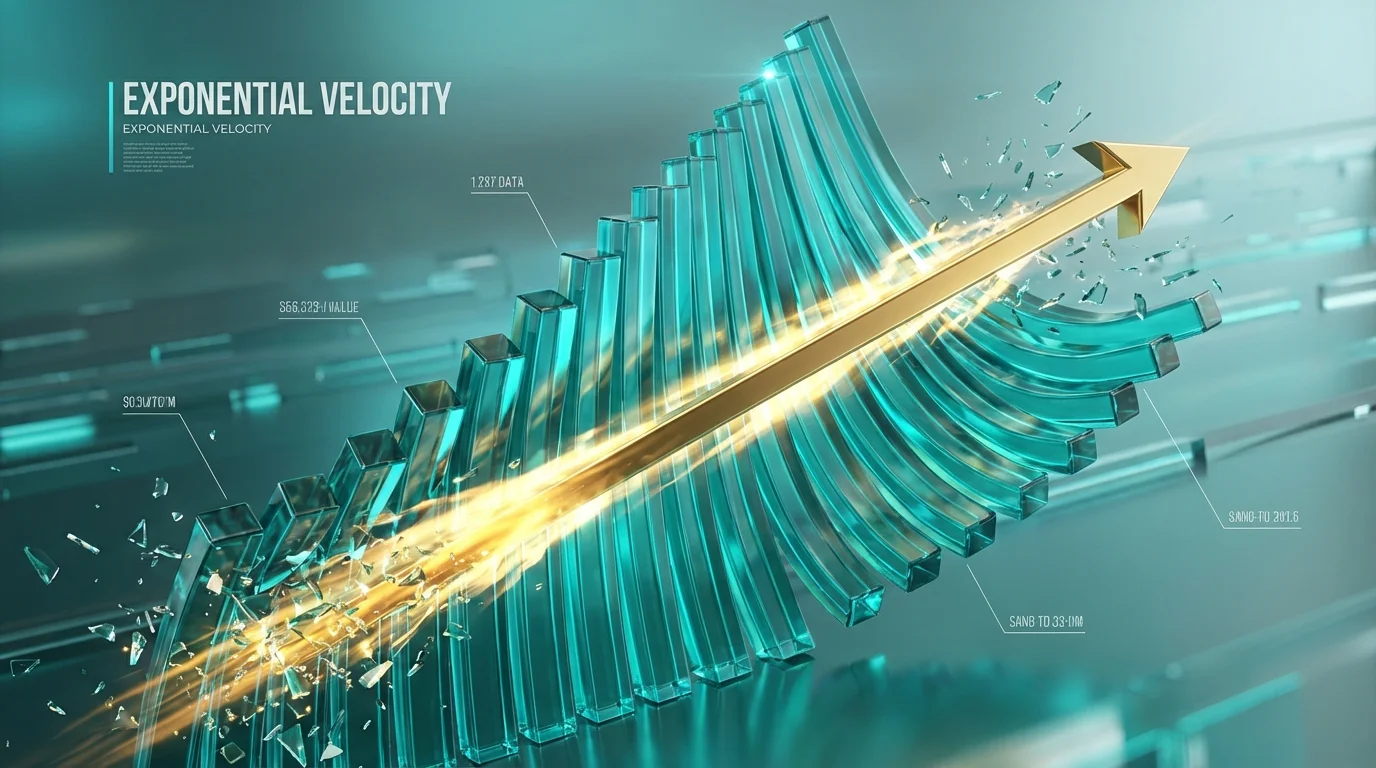
The Mathematics of Movement: Why Speed Matters
To understand why velocity matters, you must look at the “opportunity cost” of delay. Let us assume you decide to save $1,000 per month. If you let that money sit in a 0.05% checking account for six months before moving it into an investment yielding 7%, you aren’t just losing the interest on that $1,000—you are losing the compounding power of that interest over the next thirty years.
Consider the “Cost of Waiting” data frequently cited by financial planners. If you start investing $500 a month at age 25, assuming a 7% annual return, you will have roughly $1.3 million by age 65. If you wait until age 35 to start—perhaps because you were “waiting for the right time” or letting cash pile up in a checking account—you would only have about $600,000. That ten-year delay, or “low velocity” in your early years, costs you over half a million dollars.
Your goal is to decrease the time between earning a dollar and putting it into a “growth engine.” This is why wealth building is often less about how much you earn and more about how efficiently you move what you earn. You can use tools provided by Investopedia to calculate your own compound interest projections and see how speed impacts your bottom line.

Pitfalls to Watch For
While high money velocity is generally positive, moving money too fast without a strategy can lead to significant setbacks. You must balance speed with friction costs—taxes, fees, and penalties that “shave off” parts of your dollar as it moves.
- The Liquidity Trap: If you move 100% of your excess cash into a 401(k) or a 5-year CD (Certificate of Deposit), you have high velocity into an asset but zero liquidity. If your car breaks down, you might be forced to use a credit card at 24% APR or take a premature withdrawal penalty. Always maintain a “buffer” in a medium-velocity account.
- Over-Trading: In a brokerage account, “velocity” can be a curse. Buying and selling stocks daily creates tax liabilities (Short-Term Capital Gains) and potential commission fees. In your investment accounts, you want inbound velocity (moving money in quickly) but internal stillness (holding assets long-term).
- Transaction Fees: Be wary of accounts that charge for outgoing transfers. Some savings accounts limit you to six withdrawals per month (though Regulation D was suspended, many banks still enforce these rules). Check your bank’s fine print to ensure your efficient banking strategy isn’t being eaten alive by $15 transfer fees.
- The Float Fallacy: Using credit cards for everything can increase your velocity by keeping cash in your savings account longer (earning interest). However, if you cannot pay the statement in full every month, the interest you pay will dwarf any interest you earned.
“Our favorite holding period is forever.” — Warren Buffett, Chairman and CEO of Berkshire Hathaway

Optimizing Cash Flow: The “Bucket” Method
A practical way to manage your velocity of money is to envision your finances as a series of buckets connected by pipes. The pipes are your automated transfers. If the pipes are too narrow, money overflows (stays in the wrong account). If they are too wide, your buckets empty too quickly.
The first bucket is Immediate Needs. This should hold exactly 1.5 times your monthly expenses. This provides a buffer so you never bounce a check, but it is small enough that you aren’t keeping too much “lazy money” in a low-yield environment.
The second bucket is Short-Term Security. This is your emergency fund, held in an HYSA. Check current rates at Bankrate to ensure your “security bucket” is at least keeping pace with inflation. Once this bucket reaches its target (usually 3–6 months of expenses), the “pipe” leading into it should be redirected to the next bucket.
The third bucket is Wealth Growth. This includes your Roth IRA, 401(k), and taxable brokerage. This is where you want the highest volume of your excess cash flow to end up. Once money enters this bucket, the exit pipe should be sealed until retirement or a major planned life event.
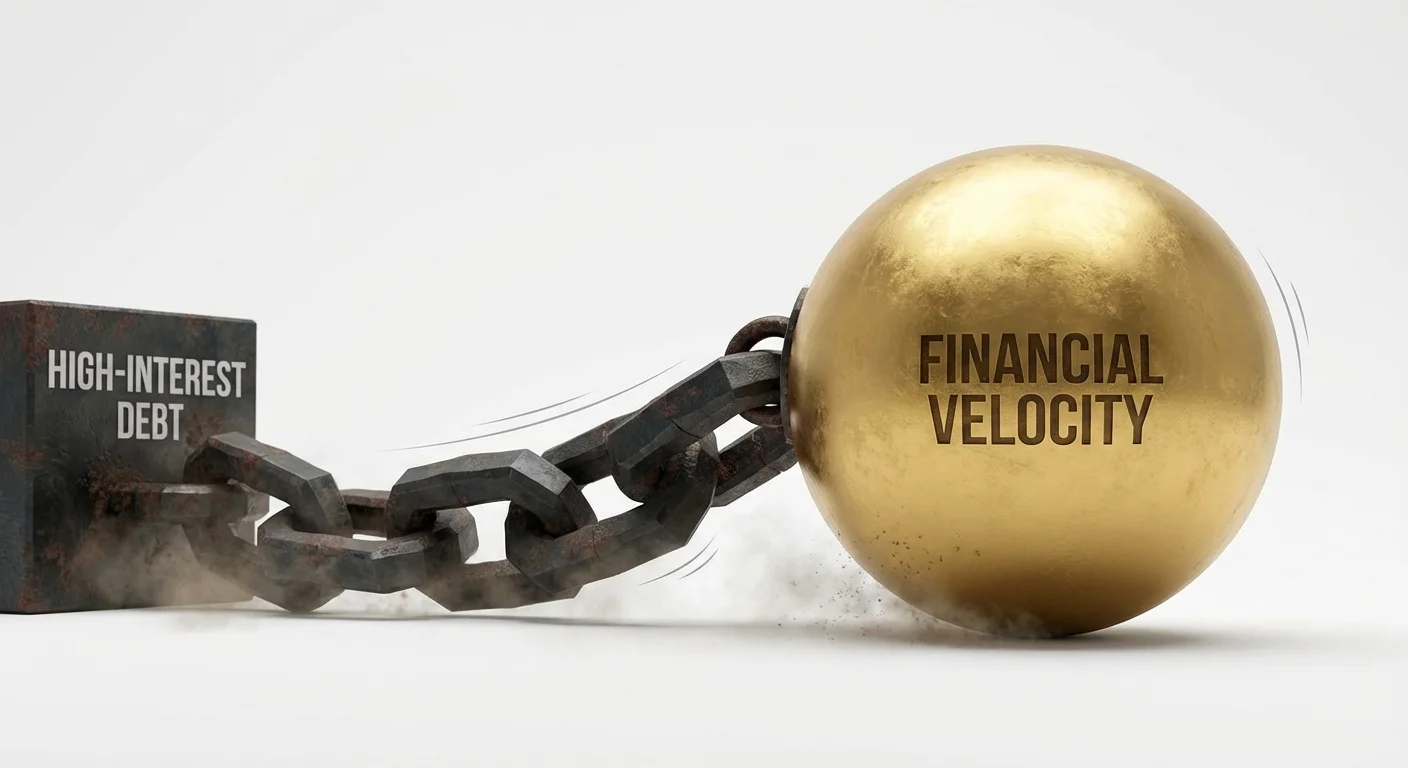
The Role of Debt in Money Velocity
Debt is essentially “negative velocity.” It is a claim on your future income that forces you to move money toward someone else’s growth engine instead of your own. However, not all debt should be treated with the same urgency. To manage your cash flow management effectively, you must distinguish between high-velocity debt and low-velocity debt.
High-velocity debt includes credit cards (20%+ interest) and payday loans. These are financial emergencies. The velocity of money moving toward these debts should be your absolute highest priority. Every dollar used to pay down a 20% interest card is a guaranteed 20% “return” on your money.
Low-velocity debt, such as a 3% mortgage or a 4% student loan, requires a different approach. If your HYSA is paying 4.5% and your mortgage is 3%, your money actually has higher “utility” sitting in your savings account than being used for extra mortgage payments. In this scenario, you are utilizing an “arbitrage” strategy—earning more on your cash than it costs you to borrow. For guidance on managing student debt specifically, the USA.gov Benefits portal provides resources on repayment plans that can help you optimize your cash flow.

Wealth Building Through “The Gap”
The most important metric in your personal velocity is the “Gap”—the distance between your income and your expenses. If you earn $5,000 and spend $4,500, your wealth-building velocity is capped at $500 per month. To increase velocity, you can either increase the “pressure” (earn more) or reduce the “leaks” (spend less).
Many people focus solely on the leaks. They cut out lattes or cancel a streaming service. While helpful, these are small adjustments to the flow. To truly accelerate your wealth building, you must focus on the large-scale movements: your housing costs, your transportation costs, and your tax efficiency. Moving $2,000 a year from a traditional savings account to a tax-advantaged Roth IRA can result in tens of thousands of dollars in tax savings over your lifetime. That is high-velocity thinking.
Getting Expert Help
While the principles of money velocity are straightforward, implementing them can be complex depending on your life stage. You might consider seeking professional guidance in the following scenarios:
- Tax Complexity: If you are moving large sums between taxable and tax-advantaged accounts, a CPA can help you avoid unintended tax triggers.
- Windfalls: If you receive an inheritance or a large bonus, a fee-only financial planner can help you “deploy” that capital quickly to avoid the trap of lazy money.
- Debt Overload: If your debt payments exceed 40% of your income, organizations like the National Foundation for Credit Counseling (NFCC) can help you restructure your flow.
- Retirement Transition: As you move from the “accumulation” phase (high inbound velocity) to the “distribution” phase (controlled outbound velocity), a Certified Financial Planner (CFP) can help you create a sustainable withdrawal strategy.
Frequently Asked Questions
Is it ever okay to have “slow” money?
Yes. Your emergency fund should be slow. Its purpose is not growth; its purpose is insurance. You pay a “premium” for this insurance in the form of lower returns compared to the stock market. Accept this as a necessary cost of financial stability.
Should I move my money into the stock market all at once or slowly?
This is the classic debate between Lump Sum investing and Dollar Cost Averaging (DCA). Data from Vanguard and other institutions suggests that lump-sum investing (high velocity) beats DCA about 66% of the time because it gets more capital working sooner. However, if a lump sum move would cause you significant anxiety, DCA is a perfectly valid way to move money steadily into the market.
Does automation actually increase wealth?
Absolutely. Human beings are prone to “decision fatigue.” By automating your money’s velocity, you remove the need to be disciplined every single month. Automation ensures that your wealth building happens in the background, regardless of your mood or memory.
Practical Next Steps
Take an hour this weekend to audit your “dwell times.” Look at your bank statements and identify exactly how much cash is sitting in your checking account three days before your next payday. If that number is consistently higher than $2,000 (or whatever your specific “buffer” needs to be), you have identified a pool of lazy money. Set up an automatic transfer to move that excess into a more productive account—either a high-yield savings account for short-term goals or a brokerage account for long-term growth.
Your financial health is determined by the movement of your dollars. When you increase the velocity of your money, you aren’t just managing cash; you are buying back your future time. Treat your accounts like a high-speed rail system: keep the transfers efficient, the destinations clear, and the “dwell time” to an absolute minimum.
The information in this guide is meant for educational purposes. Your specific circumstances—including income, debt, tax situation, and goals—may require different approaches. When in doubt, consult a licensed professional.
Last updated: February 2026. Financial regulations and rates change frequently—verify current details with official sources.









Leave a Reply