State laws generally separate electric bicycles from motorized vehicles at a 750-watt motor cap and assisted speeds of 20 to 28 mph. Most homeowners and renters insurers rely on those thresholds and your policy’s vehicle definitions to decide whether your ride has coverage.
Even when a lower-speed e-bike qualifies as personal property, a standard policy typically leaves two major gaps: depreciated theft payouts after a deductible and zero liability coverage for crashes. Stand-up electric scooters and higher-powered rides usually face total exclusion.
How Homeowners Policies Treat E-Bike Classes and Scooters
Standard HO-3 homeowners and renters insurance policies cover bicycles as personal property for fire and theft, minus your deductible. Adding a motor forces insurers to check state classifications and policy definitions before extending that protection.
Across most states, PeopleForBikes’ three-tier e-bike framework caps motors at 750 watts and separates pedal-assist models from higher-speed bikes. Electric scooters and devices without functional pedals fall outside bicycle definitions in many states, triggering the motorized vehicle exclusion.
| Vehicle Category | Motor and Speed Definition | Typical State Classification | Typical ISO HO-3 Carrier Treatment |
|---|---|---|---|
| Class 1 E-Bike | Pedal-assist only, up to 20 mph (750W max) | Exempt from motor vehicle registration in most states | Often covered under personal property; liability varies by carrier |
| Class 2 E-Bike | Throttle-capable, motor stops at 20 mph (750W max) | Exempt from motor vehicle registration in most states | Sometimes covered for theft; throttle triggers liability exclusions at some carriers |
| Class 3 E-Bike | Pedal-assist only, up to 28 mph (750W max) | Subject to higher age, helmet, or bike-path rules | Frequently excluded from liability and off-premises property coverage |
| High-Powered E-Bike or E-Scooter | Over 750W, over 28 mph, or stand-up electric scooter | Often classified as a moped, motorcycle, or motor-driven device | Generally excluded from both personal property and personal liability |
Theft Payouts, Deductibles, and the Depreciation Math
Even when an insurer treats a Class 1 e-bike as personal property, HO-3 Coverage C category sublimits often cap payouts on sporting gear or bikes at $1,000 to $1,500. A $3,000 commuter e-bike stolen from a store rack can exceed that cap immediately.
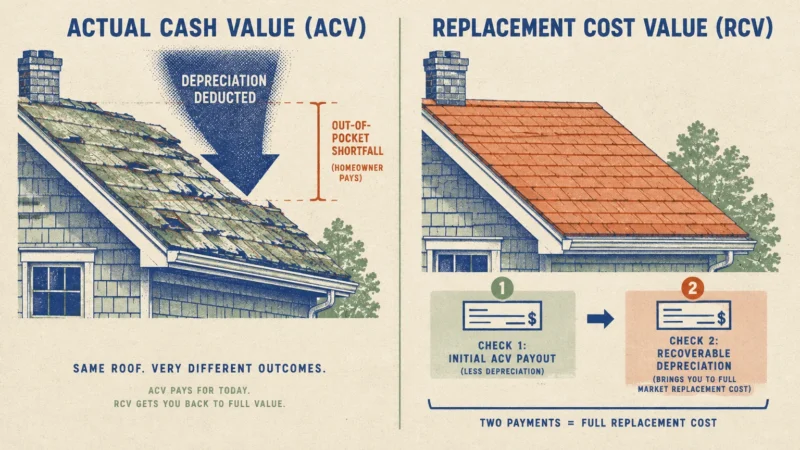
Settlement terms shrink the check further when a policy pays actual cash value versus replacement cost. Under an actual cash value settlement, the insurer subtracts depreciation for battery wear and frame age before applying your deductible.
A stolen three-year-old Class 1 e-bike with a $3,000 replacement cost drops to $1,800 under 40% depreciation. Subtracting a $1,000 deductible leaves an $800 insurance payout and $2,200 out of pocket.
By contrast, a standalone policy with replacement cost coverage and a $200 deductible pays $2,800 on that same $3,000 loss. Filing a theft claim on your homeowners policy can also raise your renewal premium for three to five years.
Liability Risks for Owned and Rented E-Scooters
Losing a $3,000 bike hurts your budget, but injuring a pedestrian or damaging a parked car creates six-figure legal exposure. Standard homeowners and renters policies typically exclude liability from motorized vehicles, which commonly removes protection when you ride an e-scooter or high-powered e-bike.
Rental app scooters from providers like Lime or Bird carry the same hazard. When you accept the app terms, you generally assume legal responsibility for injuries or property damage you cause, while your homeowners policy still excludes non-owned motorized vehicles.
A personal umbrella policy adds extra liability limits above your underlying coverage, yet it will not step in if the underlying homeowners policy excludes e-bikes. Confirm in writing whether your umbrella carrier requires a recreational vehicle endorsement before riding.
Homeowners vs. Scheduled Rider vs. Standalone E-Bike Insurance
When homeowners coverage falls short, riders generally choose between adding a scheduled personal property endorsement and buying a standalone policy from a bicycle specialist. Each option solves a different piece of the risk.
Adding a rider raises your theft limit and often lowers your deductible to $0, yet many riders still omit third-party liability and crash damage. Standalone policies from specialists like Velosurance, Markel, or Spoke function more like auto coverage for bikes.
Standalone e-bike insurance typically costs between $100 and $300 per year depending on the bike’s value, deductible, and location, according to published pricing from specialist insurer Velosurance, underwritten by Markel. That cost often includes coverage homeowners policies lack:
- Replacement cost payout: Pays the full cost to replace your bike with a comparable current model rather than a depreciated figure.
- Third-party liability and medical payments: Covers injuries or property damage you cause to others, plus limited no-fault medical bills for your own crash injuries.
- Uninsured and underinsured motorist coverage: Pays for your medical expenses and bike repairs if an uninsured or hit-and-run driver strikes you.
- Roadside assistance: Covers transport back home or to a repair shop if your battery fails or a component breaks mid-ride.
| Coverage Feature | Standard Homeowners (HO-3) | Scheduled Personal Property Rider | Standalone E-Bike Policy |
|---|---|---|---|
| Theft Protection | Limited by deductible and bike sublimits | Full scheduled value, often $0 deductible | Full replacement cost minus chosen deductible |
| Liability Coverage | Often excluded for motorized bikes and scooters | Usually adds no liability beyond base policy | Vehicle-specific liability option available |
| Crash and Accidental Damage | Rarely covered | Covered only on select all-risk endorsements | Standard coverage for collisions and drops |
| Away-From-Home Transit | Subject to off-premises sublimits | Worldwide coverage | Worldwide coverage included |
Lithium-Ion Battery Fires and 2026 Certification Rules
If an e-bike battery starts an accidental fire that damages your home, a standard HO-3 homeowners policy will typically cover structural damage to the house. However, insurers commonly exclude the e-bike itself under motorized vehicle clauses.
Battery safety rules tightened in 2026 after rising lithium-ion fire incidents and 135 micromobility-related fatalities recorded in 2024 by the Consumer Product Safety Commission. On June 24, 2026, the agency proposed mandatory UL 2849, UL 2272, and UL 2271 compliance for e-bikes, scooters, and batteries.
State laws and landlords are moving ahead of federal mandates. Under California Senate Bill 1271, effective January 1, 2026, new e-bikes, powered mobility devices, and replacement batteries sold in the state must carry accredited third-party certification such as UL 2849 or EN 15194.
Using uncertified aftermarket batteries, modified controllers, or mismatched chargers can trigger claim investigations or coverage denials if a charging fire occurs. Keep proof of UL certification alongside your purchase receipt.
How to Audit Your Policy Before You Ride
Open your homeowners or renters declarations page and search the policy PDF for the exact phrases “motorized land vehicle” and “bicycle.” Policy wording varies by insurer, and adjusters apply written definitions rather than marketing summaries.
Ask your agent or underwriting department to confirm in writing whether your specific class, motor wattage, and top speed qualify for personal property theft coverage, what sublimit applies, and whether liability follows you off your property.
Document your ride before a claim happens and verify every security condition in your policy. Insurers frequently deny theft claims if you omit a required hardened steel U-lock, cannot produce a serial number, or modified the motor past its declared class.
Daily commuters, owners of high-value bikes, and DoorDash or UberEats delivery riders should consult an independent insurance broker to compare commercial or standalone policies. Always get written confirmation from the underwriter before relying on personal coverage for work trips.
Commuting, Delivery Gigs, and Electric Skateboards
Commuting vs. App-Based Delivery Gigs
Commuting to your workplace is personal use and qualifies under standard policies that allow e-bikes as well as standalone bicycle policies. Delivering food or packages for pay counts as commercial activity, which personal policies exclude without a commercial endorsement.
Electric Skateboards and One-Wheel Boards
Electric skateboards, hoverboards, and self-balancing unicycles almost always fall under the motorized land vehicle exclusion because they lack pedals and bicycle classifications under state law. Expect zero liability protection and likely theft exclusions unless a specialty policy explicitly lists the device.