When an unmarried, Single-filing aging parent faces sudden hospitalization or evacuation, an adult child needs immediate proof of identity, account authority, and tax status. FEMA’s Emergency Financial First Aid Kit organizes those core financial records.
Standard disaster binders fail solo households because they stop at collecting paper copies. Without pre-cleared bank powers of attorney and non-SMS digital backups, storm closures, sole-owner box freezes, and locked phones halt bill payments during an emergency.
A usable plan pairs a UL Class 350 home safe with a zero-knowledge vault configured for delegated takeover. It also pre-clears durable financial powers of attorney—complete with statutory hot-power phrasing—at every bank, brokerage, and federal agency beforehand.
Identity Records That Stop Recovery Delays
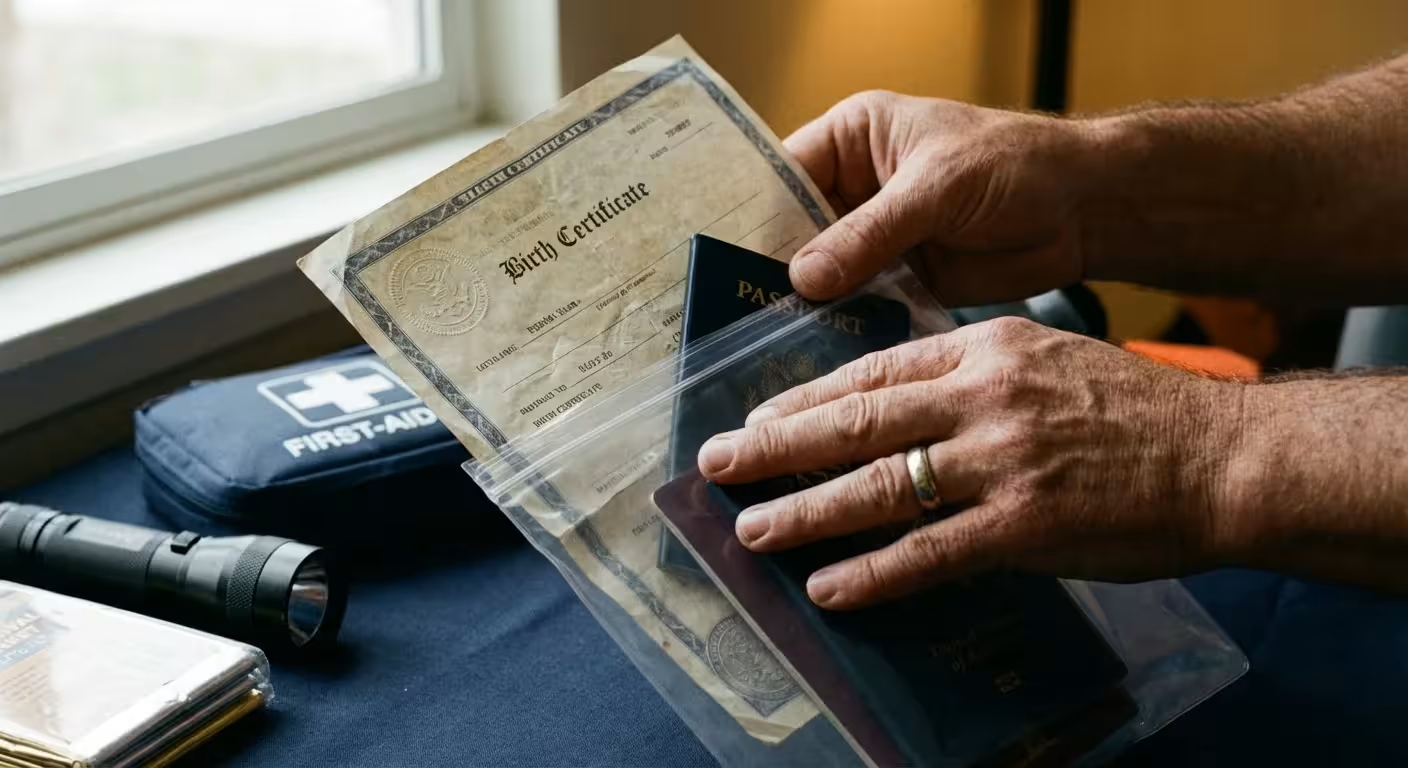
When a hospitalized Single parent cannot answer security questions, banks and insurers demand secondary federal or county identification before speaking with relatives. Confirm passport expiration dates six months ahead and keep certified civil records outside bank vaults.
Federal agencies do not issue birth, marriage, divorce, or death certificates, which come solely from state or county vital records offices. Ordering certified duplicates early prevents post-disaster backlogs when proving citizenship, prior name changes, or veteran status on DD Form 214.
Eligible U.S. citizens age 18 or older can request a free replacement Social Security card through the Social Security Administration. If a valid passport disappears, file Form DS-64 with the State Department immediately to cancel it.
Single-Filer Account Inventories and Tax Backups
When an unmarried parent manages bills alone, no spouse holds joint signature authority during an ICU stay. Completing the co-branded CFPB and FEMA Your Disaster Checklist puts every institution, account purpose, and toll-free hotline on one sheet.
Record each institution name, last four account digits, named beneficiary, and loan or VIN number rather than hoarding monthly statements. Verify deposit totals against the $250,000 FDIC limit alongside the parent’s emergency fund, and confirm IRA beneficiaries.
Log recorded property deeds, vehicle titles, and hardware cryptocurrency wallet locations on the index, locking seed phrases separately inside the safe. Direct beneficiary and payable-on-death elections pass single-filer assets outside probate and stop dormant accounts from escheating to state unclaimed property.
The IRS disaster preparedness guide recommends paperless statements, three years of scanned tax returns with W-2s and 1099s, and out-of-area backups. If paper returns are lost, an authorized representative can request free IRS return transcripts.
Institutional POA Clearance and Statutory Hot-Power Phrasing
Unmarried parents face an immediate legal wall when incapacitated because retail banks routinely reject unfamiliar third-party powers of attorney for multi-week legal review. Pre-clearing the document with each institution’s POA desk prevents mortgage, tax, and care-payment freezes.
State statutes dictate whether execution requires a notary acknowledgment, two disinterested adult witnesses, or both, and real estate authority often requires county recording. Neither the named agent nor an estate beneficiary should sign as a witness.
Under the Uniform Power of Attorney Act, authority is durable by default, whereas non-uniform states require explicit survival text. Attorneys verify phrasing such as: “This power of attorney shall not be affected by the principal’s subsequent disability or incapacity.”
Even with durability confirmed, statutory forms under Uniform Power of Attorney Act Section 201(a) exclude high-risk actions unless separately initialed or stated. Review four clearance requirements and statutory phrases with an estate-planning attorney before filing with banks:
- Immediate Authority Over Springing Triggers: A springing POA requires written physician incapacity certifications before taking effect, delaying urgent bills during hospital transfers. Immediate durable authority lets the agent act once cleared.
- Express “Hot Powers” Phrasing: Statutory forms require separate principal initials and express grants to “create, amend, revoke, or terminate an inter vivos trust,” “make a gift,” “create or change rights of survivorship,” or “create or change a beneficiary designation.”
- Bank and Brokerage POA-Desk Packets: Institutions frequently require an executed POA copy, a signed Agent’s Certification of Validity, government photo ID for the agent, and proprietary brokerage forms if third-party indemnification clauses are missing.
- Federal Agency Exclusions: State POAs do not bind federal programs. Social Security requires a separate Representative Payee application via Form SSA-11, and IRS tax representation requires IRS Form 2848 or Form 8821.
Pair the financial POA with a healthcare proxy and living will following National Institute on Aging advance care planning guidance. Also include a signed will or revocable living trust summary and Certification of Trust.
Add one-page insurance declarations for homeowners, auto, umbrella, life, and health coverage so relatives can start loss of use coverage claims right away. Consult an estate-planning attorney on state POA formalities and a CPA or enrolled agent for tax filings.

Worked Example: A Single-Filing Parent’s 2026 Readiness File
Consider an unmarried 67-year-old parent filing Single in 2026 with $68,000 in modified adjusted gross income, $185,000 in bank deposits, a $420,000 Traditional IRA, and a mortgaged home. An adult child helps assemble and pre-clear the household’s readiness packet.
First, the adult child verifies that the $185,000 deposit balance sits inside the $250,000 FDIC limit per depositor, per insured bank, per ownership category. Under FDIC guidance on safe deposit boxes, box contents carry zero deposit insurance.
Second, the adult child logs the parent’s 2026 Single-filer deductions: a $16,100 standard deduction, $2,050 for age 65 or older, and the $6,000 temporary senior deduction. Because $68,000 MAGI sits below the $75,000 phase-out, total deductions reach $24,150.
Subtracting $24,150 leaves $43,850 in taxable income, which sits in the 12% bracket and produces $5,014 in 2026 federal tax. When IRA withdrawals lack withholding, estimated tax deadlines fall on April 15, June 15, September 15, and January 15.
With IRS Direct File ended after 2025, the packet notes IRS Free File software and stores an executed IRS Form 2848. For 2027, the IRS announced a $16,600 Single standard deduction, $2,100 age-65+ deduction, and $95,000 Free File AGI limit.
Finally, the parent’s net worth falls far below the $15,000,000 permanent federal estate exemption for 2026, which rises to $15,480,000 for 2027. Pre-clearing the durable financial POA and hot-power beneficiary clauses with the bank and IRA custodian therefore outranks complex estate-tax trusts.
Fire-Safe Specifications and Document Storage Matrix
Bank safe deposit boxes block agents during storm closures and freeze at a sole owner’s death until probate opens. Store originals in a bolted, waterproof UL Class 350 home safe keeping interior heat below 350°F for one hour.
Give the adult child the spare safe key or combination. Keep the original Social Security card locked inside the safe, packing only a redacted note inside the evacuation go-bag.
| Document Category | UL Class 350 Home Safe | Evacuation Go-Bag | Zero-Knowledge Vault + Offline USB | Institutional Verification |
|---|---|---|---|---|
| Durable financial POA | Witnessed, notarized original | Signed working copy | Encrypted PDF scan | Bank POA-desk approval + Agent’s Certification |
| Social Security card | Original card | Redacted note only | Encrypted scan | SSA-11 Representative Payee check |
| U.S. passport | Original passport | Grab original on exit | Encrypted scan | 6-month expiration check |
| Birth and marriage certificates | Certified original | Certified spare copy | Encrypted scan | County registry seal check |
| Healthcare proxy and will | Signed original (or attorney vault) | Signed working copy | Encrypted PDF scan | Primary physician chart receipt |
| Deeds, titles, and declarations | Copies and declarations binder | Printed policy sheets | Encrypted PDF + offline sync | Loan and policy numbers verified |
| Tax returns, W-2/1099s, Form 2848 | Printed summary or USB | Not required | Out-of-area backup | IRS transcript and Form 2848 check |

Digital Vault and MFA Configurations for Family Access
Unencrypted email attachments or consumer notes apps expose Social Security numbers and IRA details during account breaches. Store PDF scans inside a zero-knowledge encrypted cloud drive or password manager secured by a random four-word passphrase.
Following CISA multifactor authentication guidance, protect the vault with a FIDO2 hardware security key or passkey. Avoid SMS-only verification codes, which fail when an incapacitated parent’s smartphone stays locked or loses service.
Strong encryption locks out relatives unless takeover rules are configured ahead of time. Enable the password manager’s Emergency Access feature for the adult child with a set waiting period, and store the printed recovery key inside the home safe.
Add a hardware-encrypted AES-256 USB drive to the safe and turn on offline mobile sync inside the adult child’s encrypted vault app. Those two backups keep insurance declarations, Form 2848, and POA clearance letters readable during power and cellular outages.
Four-Week Execution Plan and Annual Tax Audit
Spreading assembly across four weekends lets the parent and adult child complete legal, institutional, and storage checks without fatigue. Each week produces one concrete verification artifact.
- Week 1 — Safe and Civil Originals: Bolt down the waterproof UL Class 350 safe, share the combination, check passport expiration dates, and order certified county spares.
- Week 2 — Accounts, FDIC, and Transcripts: Complete the CFPB checklist, confirm $250,000 FDIC coverage, verify IRA and bank beneficiaries, and archive three years of tax returns.
- Week 3 — State POA Execution and Institutional Clearance: Execute notarized, witnessed POAs with explicit hot-power initials, submit Agent’s Certifications to each bank’s POA desk, and file IRS Form 2848 and healthcare directives.
- Week 4 — Digital Vault and Go-Bag: Upload scans to the zero-knowledge vault, configure FIDO2 MFA and Emergency Access, load the AES-256 USB, and pack go-bag sleeves.
Revisit the kit each spring during tax document organization. File the latest tax return and Social Security benefit notice, confirm bank POA records remain active, and test Emergency Access logins.