
A simple clerical choice made decades ago at a closing table can cost your heirs six figures in avoidable taxes. When you purchase a home or open a brokerage account with a spouse or partner, you likely focus on the interest rate, the neighborhood, or the investment strategy. Rarely do people stop to interrogate the “titling” section of the paperwork. However, the way you hold title to your assets determines not only who inherits them—but also how much the IRS takes from the proceeds when those assets are eventually sold.
Most Americans hold joint assets as Joint Tenancy with Right of Survivorship. It is the default setting for many real estate agents and escrow officers because it bypasses probate—the lengthy, expensive court process used to settle estates. But for married couples in certain states, this default choice is often a strategic error. By understanding the interplay between title and the “step-up in basis,” you can protect your family’s wealth from unnecessary capital gains taxes.

Why Your Deed Is More Than Just a Document
Your title acts as a legal blueprint for the future. It dictates how property transfers after death and how the government values that property for tax purposes. To understand the stakes, you must first understand “basis.” In tax law, your basis is generally what you paid for an asset. If you buy a house for $200,000, your basis is $200,000. If you sell it later for $500,000, you owe capital gains tax on the $300,000 profit.
When someone dies, the IRS often allows a “step-up in basis.” This means the asset’s taxable value “steps up” from the original purchase price to its fair market value on the date of the owner’s death. This is one of the most powerful wealth-preservation tools in the U.S. tax code. However, the amount of that “step-up” depends entirely on whether you hold the property as Joint Tenancy or Community Property.
“The most powerful force in the universe is compound interest. But the most efficient way to keep it is to understand how the tax code treats your legacy.” — Inspired by Benjamin Franklin’s principles on wealth and frugality.

Joint Tenancy with Right of Survivorship: The Default Choice
Joint Tenancy with Right of Survivorship (JTWROS) is available in every state and is open to any two or more people—not just married couples. You might hold title this way with a spouse, a sibling, or a business partner. Under JTWROS, all owners hold an equal, undivided interest in the property. When one owner dies, their share automatically passes to the surviving owner(s) without going through probate.
While the probate avoidance is a major benefit, the tax treatment is often a drawback for married couples. Under federal law, if you hold property as JTWROS with a spouse, only the half owned by the deceased spouse receives a step-up in basis. Your half—the survivor’s half—retains its original cost basis. This is often called a “half step-up.”
Consider a couple who bought a home for $100,000 in the 1980s. Today, the home is worth $1.1 million. If they hold the title as Joint Tenants and one spouse passes away, the deceased spouse’s 50% interest ($50,000 basis) steps up to its current value ($550,000). However, the surviving spouse’s half remains at the original $50,000 basis. The new combined basis for the survivor is $600,000. If the survivor sells the house for $1.1 million, they face a taxable gain of $500,000.

The Community Property Advantage for Married Couples
If you live in one of the nine community property states—Arizona, California, Idaho, Louisiana, Nevada, New Mexico, Texas, Washington, or Wisconsin—you have a much more powerful option. In these states, assets acquired during a marriage are generally considered community property, meaning each spouse owns the whole property together rather than two distinct halves.
The Internal Revenue Code, specifically IRS Publication 551, provides a massive benefit for community property: the “double step-up.” When one spouse dies, 100% of the community property asset receives a step-up in basis to the current market value. This applies even though the surviving spouse still owns their half of the property.
Using the same example as above—a $100,000 home now worth $1.1 million—if the couple held the title as Community Property, the entire basis would step up to $1.1 million upon the first spouse’s death. If the surviving spouse sells the home shortly after, they would owe zero dollars in capital gains tax. This single distinction could save a grieving spouse over $100,000 in taxes, depending on their tax bracket and state laws.

Comparing the Tax Impact: A Side-by-Side View
The following table illustrates the difference in taxable gains for a surviving spouse based on how the couple held the title. This assumes a home purchased for $300,000 that is worth $1,000,000 at the time of the first spouse’s death.
| Factor | Joint Tenancy (JTWROS) | Community Property |
|---|---|---|
| Original Basis | $300,000 | $300,000 |
| Deceased Spouse’s Share Basis | $150,000 | $150,000 |
| Step-Up Amount | $500,000 (Deceased’s half only) | $1,000,000 (Entire property) |
| Survivor’s New Basis | $650,000 | $1,000,000 |
| Taxable Gain if Sold for $1M | $350,000 | $0 |
| Estimated Federal Tax (15% rate) | $52,500 | $0 |
This data highlights why titling is a critical component of estate planning. While Joint Tenancy is simple, Community Property is often more fiscally responsible for married couples in the appropriate jurisdictions.
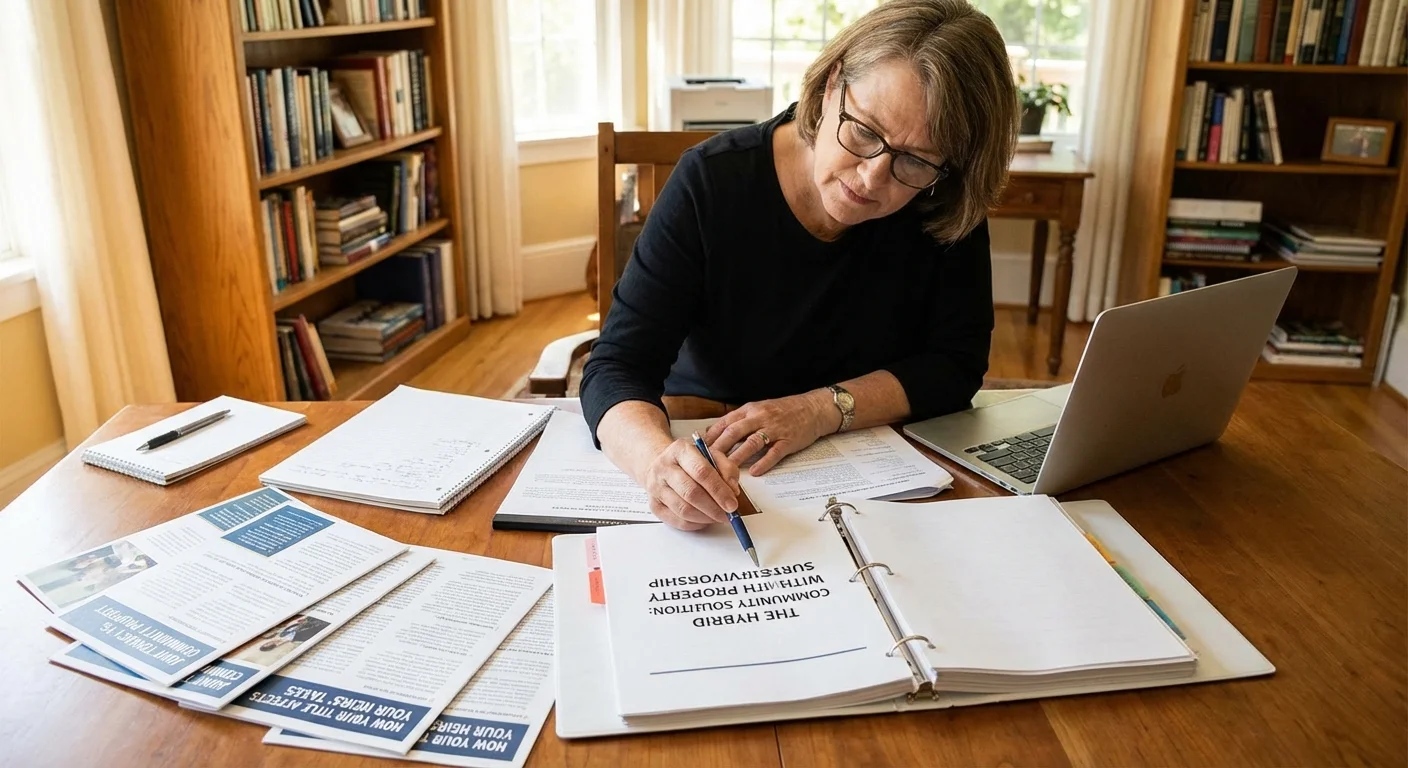
The Hybrid Solution: Community Property with Right of Survivorship
Historically, “Community Property” had one major downside: it didn’t automatically bypass probate. Unlike Joint Tenancy, traditional community property often required a court to confirm the transfer of the deceased spouse’s share. To solve this, several states (including California, Arizona, Nevada, and Texas) created a hybrid title: Community Property with Right of Survivorship (CPWROS).
This title offers you the best of both worlds. You receive the 100% double step-up in basis from the IRS, and the property transfers automatically to the surviving spouse without probate. If you live in a community property state, you should check your most recent deed. If it simply says “Joint Tenants,” you may want to record a new deed to change the status to CPWROS.
You can find more information on how the government views these property rights through the Consumer Financial Protection Bureau (CFPB), which provides resources on protecting your assets during major life transitions.

Moving Between States: The Transmutation Trap
Wealthy families often run into trouble when they move from a community property state like Washington to a common law state like Florida. Generally, property acquired in a community property state retains its character even if you move. However, if you sell your Washington home and use the proceeds to buy a Florida home as “Joint Tenants,” you might accidentally “transmute” that property into Joint Tenancy, losing your future double step-up.
Conversely, if you move from a common law state to a community property state, your existing assets do not automatically become community property. You must take active steps—often through a “Community Property Agreement” or by re-titling assets—to gain the tax advantages of your new home state. This is a nuanced area where professional guidance is mandatory.

Professional vs. Self-Guided: When to Call an Expert
While you can certainly read your own deed and look up your state’s laws, some scenarios require a specialized touch. Deciding how to title an asset is not a “set it and forget it” task. Consider these scenarios:
- Blended Families: If you have children from a previous marriage, Joint Tenancy or CPWROS might unintentionally disinherit them. In these cases, a trust is often a better vehicle than a simple title designation.
- High Net Worth: If your estate exceeds the federal estate tax exemption (which is currently high but scheduled to sunset in 2026), your titling strategy must account for both income tax (basis) and estate tax.
- Asset Protection: Some titling methods, like “Tenancy by the Entirety” (available in many common law states), provide better protection from creditors than Joint Tenancy.
- Moving Across State Lines: As mentioned, moving between community property and common law states creates a “tax character” conflict that requires a legal review.
If you find yourself in these situations, consult a Certified Financial Planner (CFP) or an estate attorney. You can verify a professional’s credentials through the CFP Board.

Common Mistakes to Avoid
Even well-intentioned homeowners make errors that haunt their heirs. Watch out for these common pitfalls:
- Adding a child to your deed as a Joint Tenant: Many parents do this to avoid probate. However, you are effectively giving your child a gift of 50% of the home. They do not get a step-up in basis on their half when you die, and the home becomes subject to their creditors (like a lawsuit or divorce).
- Failing to update titles after a divorce: If you remain on a deed as “Joint Tenants” with an ex-spouse, they may automatically inherit the property regardless of what your will says.
- Assuming a Will overrides a Title: This is a massive misconception. Titling (like JTWROS) is a “non-probate” transfer. It happens automatically by operation of law. Even if your will says your sister gets the house, if the house is titled as Joint Tenancy with your brother, your brother gets the house.
- Ignoring “Basis” in non-real estate assets: This logic applies to brokerage accounts too. Holding stocks in a community property account can be far more tax-efficient than holding them in a joint brokerage account.
Frequently Asked Questions
Can I use community property titling if I’m not married?
No. Community property is a legal status reserved for married couples (and registered domestic partners in some states like California and Washington). Unmarried partners usually use Joint Tenancy or Tenancy in Common.
What if I live in a state that doesn’t have community property?
If you live in a common law state (like New York or Florida), you generally cannot use community property titling for real estate located in that state. However, some states allow you to create a “Community Property Trust” to opt-in to these tax benefits. This is a complex strategy that requires an experienced attorney.
Does the step-up in basis apply to 401(k)s or IRAs?
No. Retirement accounts are considered “Income in Respect of a Decedent” (IRD). They do not receive a step-up in basis because the money was never taxed in the first place. This is why titling and basis strategies are primarily focused on “taxable” assets like homes, stocks, and businesses. You can learn more about retirement distributions at Social Security Administration or IRS portals.
Is there a downside to Community Property?
The primary downside is “full exposure.” In a community property state, the entire asset is generally considered owned by both spouses. This means if one spouse is sued, the entire asset could be at risk, whereas in some other titling forms, only the debtor-spouse’s half might be reachable.
Review your financial landscape today. Pull your most recent property deed or brokerage statement and look at the “Ownership” or “Title” section. If you are married and living in a community property state, ensure your title reflects your desire for tax efficiency. Small adjustments now—such as recording a quitclaim deed to move from Joint Tenancy to Community Property with Right of Survivorship—can provide your spouse or children with significant financial relief during a difficult time.
This is educational content based on general financial principles. Individual results vary based on your situation. Always verify current tax laws and regulations with official sources like the IRS or CFPB. For specific legal or tax advice, consult with a qualified professional in your jurisdiction.
Last updated: February 2026. Financial regulations and rates change frequently—verify current details with official sources.









Leave a Reply