
Most investors spend hundreds of hours researching which stocks to buy or which ETFs offer the lowest expense ratios. They obsess over market timing and economic indicators. Yet, many of these same investors ignore a silent partner that takes a massive, recurring cut of their wealth: the Internal Revenue Service. While you cannot control market volatility or interest rate hikes, you have significant control over how much of your profit you keep versus how much you hand over in taxes.
Tax-efficient fund placement—commonly referred to as asset location—is the strategy of distributing your investments across different account types to minimize your lifetime tax burden. This is distinct from asset allocation, which dictates the mix of stocks and bonds in your portfolio. Asset location focuses on the where rather than the what. Research from financial institutions like Vanguard and Morningstar suggests that proper asset location can add an estimated 0.5% to 0.75% in additional after-tax returns annually. Over a thirty-year investing horizon, that “tax alpha” can translate into hundreds of thousands of dollars in extra retirement savings.

The Difference Between Asset Allocation and Asset Location
Before diving into the technical details, you must understand the boundary between these two concepts. Asset allocation is your master blueprint; it determines your risk profile by deciding you want, for example, 70% equities and 30% fixed income. Asset location is the logistical plan that decides which specific account holds those assets.
If you have $500,000 to invest across a taxable brokerage account, a Traditional 401(k), and a Roth IRA, your asset allocation might tell you to put $350,000 in stocks and $150,000 in bonds. Asset location then asks: Which of those accounts should hold the bonds, and which should hold the stocks? Making the wrong choice—such as putting high-dividend REITs in a taxable account while keeping municipal bonds in a 401(k)—can create a significant “tax drag” that slows your portfolio’s growth every single year.
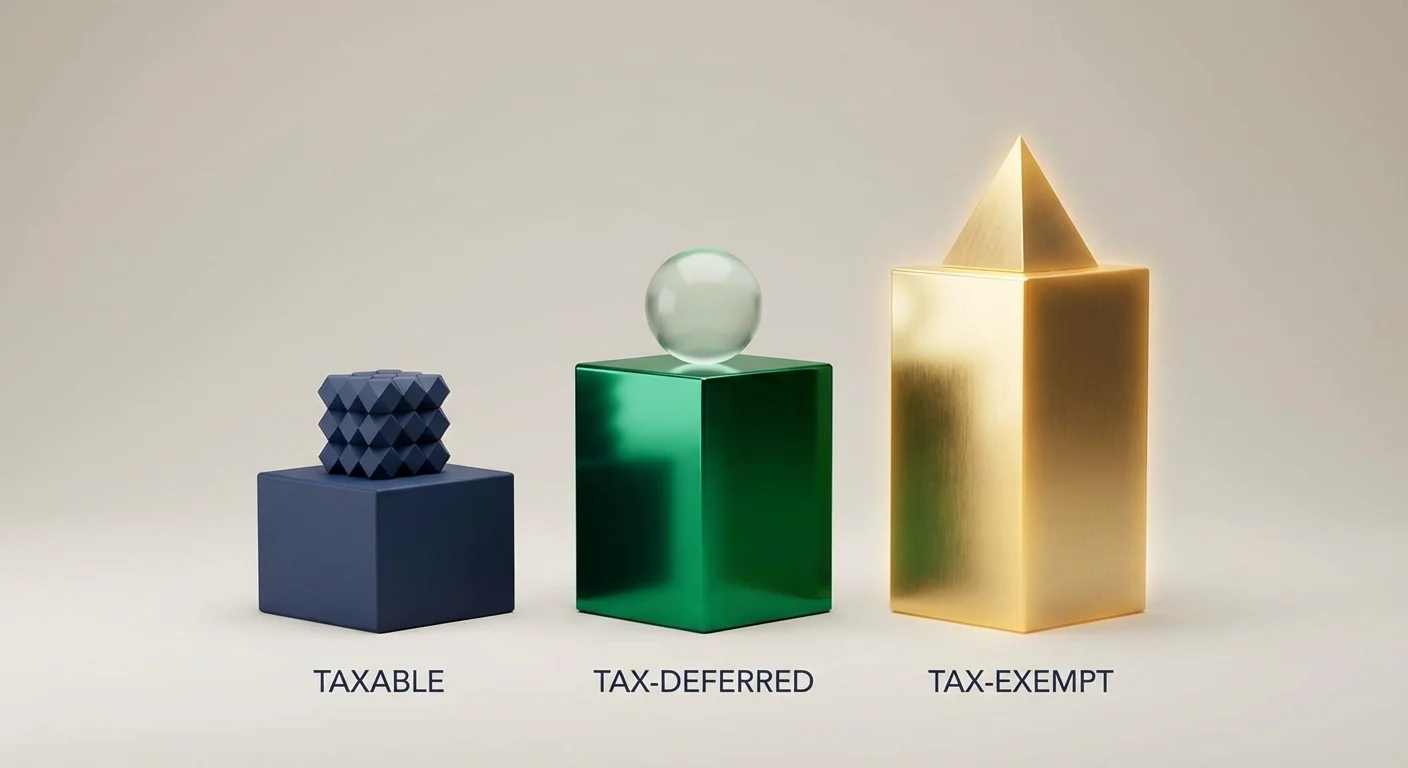
Understanding Your Three Tax Buckets
To master asset location, you must categorize your investment accounts into three primary buckets based on how the Internal Revenue Service treats the money entering and leaving them. Each bucket serves a specific purpose in a tax-efficient strategy.
1. Taxable Accounts: These are standard individual or joint brokerage accounts. You fund them with after-tax dollars. Every year, you pay taxes on interest, dividends, and any realized capital gains. However, these accounts offer the most flexibility and access to lower long-term capital gains rates (0%, 15%, or 20% depending on your income) rather than higher ordinary income rates.
2. Tax-Deferred Accounts: This category includes Traditional IRAs, 401(k)s, and 403(b)s. You typically contribute pre-tax dollars, which lowers your current taxable income. The investments grow tax-deferred—meaning you pay no taxes on dividends or capital gains inside the account—but every dollar you withdraw in retirement is taxed as ordinary income.
3. Tax-Exempt Accounts: These are Roth IRAs and Roth 401(k)s. You contribute after-tax money, but the investments grow entirely tax-free. As long as you follow the rules, you will never pay taxes on the growth or the withdrawals. This makes the Roth bucket the most valuable “real estate” in your portfolio.
“In this world, nothing is certain except death and taxes.” — Benjamin Franklin

Ranking Assets by Tax Efficiency
Not all investments are created equal in the eyes of the tax man. Some generate heavy annual tax bills, while others are naturally “quiet” and generate very little taxable activity. To optimize your placement, you should categorize your holdings from most efficient to least efficient.
- High Efficiency (Best for Taxable Accounts): Total market stock index funds, municipal bonds, and exchange-traded funds (ETFs) with low turnover. These generate minimal dividends or focus on capital appreciation that isn’t taxed until you sell.
- Moderate Efficiency: Active stock funds, balanced funds, and corporate bonds. These produce regular income or capital gains distributions that create an annual tax liability.
- Low Efficiency (Best for Tax-Advantaged Accounts): Real Estate Investment Trusts (REITs), high-yield “junk” bonds, actively managed funds with high turnover, and commodities. These often produce income that is taxed at your full ordinary income tax rate.

The Critical Importance of Bond Tax Treatment
The way you handle fixed income can make or break your asset location strategy. Bond tax treatment is particularly punishing in taxable brokerage accounts because most bond interest is considered “ordinary income.” If you are in the 32% or 37% tax bracket, the IRS will take more than a third of your interest payments every year.
If you hold taxable corporate bonds or Treasury bonds, you should prioritize placing them in your Traditional IRA or 401(k). By doing so, you shield that interest from annual taxation, allowing the full payment to compound over time. Conversely, if your tax-advantaged accounts are already full and you still need to hold bonds in your taxable account, you should look toward municipal bonds. “Munis” are generally exempt from federal income taxes and, in many cases, state taxes if you live in the state of issuance. However, because they offer this tax benefit, they typically pay lower interest rates than corporate bonds. You must calculate the “tax-equivalent yield” to determine if a municipal bond is a better deal for you than a taxable bond after accounting for your specific tax bracket.

Maximizing the Power of the Roth IRA
Since the Roth IRA offers total tax-free growth, you want to fill it with the assets that have the highest potential for appreciation. If you have two investments—one expected to grow by 4% annually (like a bond fund) and one expected to grow by 10% annually (like an emerging markets or small-cap stock fund)—you want the 10% gainer in the Roth. Over decades, the difference in the tax-free “pot” at the end will be staggering.
Many investors mistakenly put their safest, lowest-growth assets in their Roth accounts because they want to “protect” that tax-free status. In reality, you are wasting the account’s potential. Use your Roth for aggressive growth stocks, sector-specific ETFs, or high-growth international equities. Let your Traditional IRA or 401(k) handle the slower-growing, income-producing assets like bonds.

The Nuance of International Stocks and the Foreign Tax Credit
International investing adds a layer of complexity to fund placement. Many foreign governments withhold taxes on dividends paid to U.S. investors. If you hold an international stock fund in a taxable brokerage account, you can often claim the Foreign Tax Credit (IRS Form 1116) to offset these taxes on your U.S. return. This effectively lowers the cost of the investment.
However, if you hold that same international fund in a 401(k) or IRA, you cannot claim the Foreign Tax Credit. The foreign taxes are still withheld, but the credit is lost forever. For this reason, many tax experts suggest placing international equity funds in taxable accounts first, provided the fund is a low-turnover index fund that won’t generate massive capital gains distributions.

REITs and the Problem of Non-Qualified Dividends
Real Estate Investment Trusts (REITs) are a popular way to add diversification and income to a portfolio. However, tax-wise, they are one of the most inefficient assets you can own. By law, REITs must distribute at least 90% of their taxable income to shareholders. Most of these distributions are “non-qualified dividends,” which do not qualify for the lower 15% or 20% capital gains rates. Instead, they are taxed at your ordinary income rate.
According to Investopedia, holding REITs in a taxable account can significantly erode your total return due to this high tax drag. Unless you are using the Section 199A deduction (which allows some taxpayers to deduct 20% of qualified business income, including REIT dividends), these assets almost always belong in a tax-deferred or tax-exempt account.

Comparison Table: Where to Place Your Assets
| Asset Class | Tax Treatment | Preferred Location |
|---|---|---|
| U.S. Total Market Index Funds | Low dividends; Long-term capital gains | Taxable Brokerage |
| Municipal Bonds | Federal (and sometimes state) tax-exempt | Taxable Brokerage |
| Taxable Bonds (Corporate/Treasury) | Ordinary Income | Traditional IRA / 401(k) |
| REITs | Non-qualified dividends (Ordinary Income) | Traditional or Roth IRA |
| Small-Cap / Aggressive Growth Stocks | High growth; Long-term capital gains | Roth IRA |
| International Stocks | Qualified dividends + Foreign Tax Credit | Taxable Brokerage |

Professional vs. Self-Guided: When Do You Need Help?
Deciding whether to manage your own asset location or hire a professional depends on the complexity of your household finances. While the basics are straightforward, certain scenarios require advanced modeling.
- The Self-Guided Approach: If you have a simple “three-fund portfolio” consisting of a U.S. stock index, an international stock index, and a total bond market index, you can likely manage location yourself. You simply place the bonds in your 401(k) and the stock indexes in your taxable and Roth accounts.
- Professional Guidance – High Tax Bracket: If you are in the 35% or 37% federal tax bracket and live in a high-tax state like California or New York, the stakes are much higher. A Certified Financial Planner (CFP) can run “what-if” scenarios to determine if the loss of the Foreign Tax Credit is worth the benefit of tax-deferral for your specific situation.
- Professional Guidance – Complex Assets: If you deal with Private Equity, Master Limited Partnerships (MLPs) that issue K-1s, or complex options strategies, the tax implications can be Byzantine. Mistakes here can lead to “Unrelated Business Taxable Income” (UBTI) issues even inside an IRA.
- Professional Guidance – Drawdown Strategy: Asset location isn’t just about the contribution phase. As you approach retirement, you need a plan for which accounts to tap first to stay in lower tax brackets. This “decumulation” strategy is often where professionals provide the most value.

Common Mistakes to Avoid
Even seasoned investors fall into traps when trying to optimize their fund placement. Avoid these common errors to keep your strategy on track:
1. Putting Municipal Bonds in a Tax-Advantaged Account: This is a classic mistake. Municipal bonds already offer a tax break in exchange for a lower yield. By putting them in an IRA, you are essentially “paying” for a tax benefit you can’t use, while wasting valuable space that could be used for higher-yielding taxable bonds.
2. Ignoring Rebalancing Consequences: When your portfolio drifts from your target allocation, you must rebalance. If you only rebalance within your taxable account, you may trigger capital gains taxes. Try to do the majority of your rebalancing inside your 401(k) or IRA, where selling winners to buy losers carries no immediate tax penalty.
3. Letting the “Tax Tail” Wag the “Investment Dog”: Never choose a bad investment just because it is tax-efficient. An asset location strategy only works if the underlying assets are sound. A low-fee, tax-inefficient fund is often still better than a high-fee, tax-efficient one.
4. Forgetting the Step-Up in Basis: For your taxable brokerage account, remember that under current law, heirs receive a “step-up in basis” to the fair market value at the time of your death. This means they can sell inherited stock and pay zero capital gains tax on the growth that occurred during your lifetime. This makes highly appreciated stocks excellent candidates for taxable accounts if you intend to leave a legacy.
Frequently Asked Questions
Is asset location the same as asset allocation?
No. Asset allocation is the mix of what you own (e.g., 60% stocks, 40% bonds). Asset location is the decision of which account holds those items (e.g., putting the stocks in a Roth IRA and the bonds in a 401(k)).
Should I always put my highest-growing assets in a Roth IRA?
Generally, yes. Because Roth IRAs are never taxed again, you want the largest amount of growth possible to happen inside that specific bucket. This maximizes the amount of money that escapes future taxation.
What if my 401(k) has terrible investment options?
This is a common dilemma. If your 401(k) only offers expensive, high-turnover funds, the high fees might outweigh the tax benefits of asset location. In this case, you might prioritize filling your taxable account or a self-directed IRA with low-cost index funds first.
Does asset location matter for small accounts?
The impact of asset location scales with the size of your portfolio. While it is a good habit to start early, the actual dollar savings on a $5,000 account are minimal. Once your portfolio reaches six figures or you enter a high tax bracket, the benefits become significant.
Taking Action on Your Portfolio
You do not need to overhaul your entire portfolio in a single day. Start by looking at your most recent consolidated statement and identifying your “least efficient” holdings—specifically REITs and high-yield bonds in taxable accounts. Moving these to a tax-deferred account is often the easiest first step toward optimization.
Review your strategy annually, especially if your income changes or the government updates tax brackets. By paying attention to where your assets live, you ensure that more of your hard-earned money stays in your pocket rather than disappearing into the friction of annual taxation. Wealth is not just about what you earn; it is about what you keep.
This article provides general financial education and information only. Everyone’s financial situation is unique—what works for others may not work for you. For personalized advice, consider consulting a qualified financial professional such as a CFP or CPA.
Last updated: February 2026. Financial regulations and rates change frequently—verify current details with official sources.









Leave a Reply