
You might think your three-year-old is too young to understand the complexities of compound interest or a diversified portfolio. While you are technically correct, you are missing a critical window of development. Researchers from the University of Cambridge found that most children form their basic money habits by the age of seven. This means the foundation for how your child will eventually view spending, saving, and delayed gratification is being laid right now, while they are still struggling to put their shoes on the correct feet.
Toddlers are like sponges, soaking up every interaction they observe. When you tap your phone at a checkout counter or swipe a plastic card, they see a magic wand that produces goods. They do not naturally see the hard work, the budgeting, or the finite nature of those digital funds. To build strong early money habits, you must make the abstract concept of money concrete. By using money games for toddlers, you transform high-level economic principles into tactile, joyful experiences that stick.

The Cognitive Foundation of Early Money Habits
Before you dive into games, you should understand what a toddler’s brain is actually capable of processing. At ages two, three, and four, children are moving from purely sensory play to symbolic play. They begin to understand that one thing can represent another—a block can be a phone, and a coin can be a “value.”
Financial education for young kids does not require spreadsheets. It requires the development of executive functions: impulse control, working memory, and cognitive flexibility. When you teach a toddler to wait for a snack, you are essentially teaching them the psychological basis for a high-yield savings account. When you ask them to choose between a sticker and a stamp because they cannot have both, you are introducing the concept of opportunity cost. These are the building blocks of financial literacy.
“The best time to start teaching your children about money is as soon as they’re old enough to know they can’t have everything they want.” — Suze Orman, Personal Finance Expert
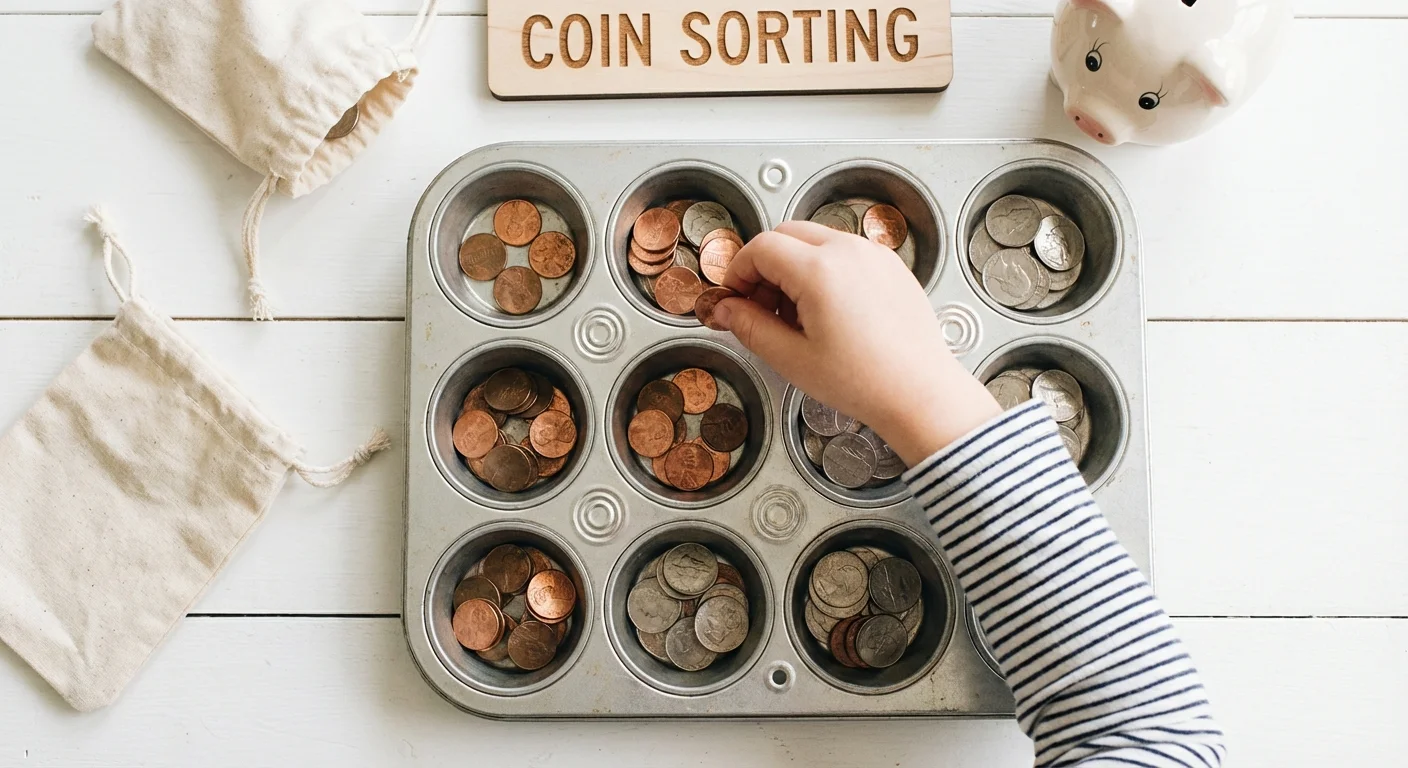
Game 1: The Great Coin Sort and Shiny Hunt
The first step in financial literacy is recognition. Toddlers need to understand that money is a specific category of object, distinct from buttons, play tokens, or rocks. This game focuses on visual discrimination and tactile familiarity.
How to Play:
Gather a large jar of mixed change. Ensure you supervise this activity closely, as coins are notorious choking hazards for young children. Dump the coins onto a soft surface like a rug. Give your toddler four different containers—muffin tins or clear plastic cups work perfectly. Tape one sample of each coin (penny, nickel, dime, quarter) to the front of each container.
Ask your child to find all the “brown ones” (pennies) first. As they move the coins, narrate the process. You might say, “That is a penny; it is worth one cent.” Once they master color sorting, move to size. Dimes are tricky because they are the smallest but worth more than pennies and nickels. Explain that even though the dime is small, it has a “secret power” that makes it worth ten pennies.
Why This Works:
This game builds the “identification” pillar of financial education. According to the Federal Deposit Insurance Corporation (FDIC), early childhood is the ideal time to introduce the physical characteristics of currency. By handling the coins, your child begins to associate money with specific physical attributes, making it “real” rather than a digital mystery.

Game 2: The Living Room Grocery Store
Once your child recognizes money, they need to understand its primary function: exchange. This is arguably the most important of all money games for toddlers because it introduces the idea that items have a cost and resources are finite.
How to Play:
Set up a “store” using items from your pantry or toy box. Use sticky notes to create simple prices using small numbers (1, 2, 5). Give your toddler a small basket and a handful of real or play coins. Act as the cashier while they play the shopper.
As they bring items to your “checkout,” explain the cost. “The apple costs two coins. Do you have two coins?” This is where the lesson in scarcity happens. If they want five items but only have three coins, you have a golden opportunity to teach prioritization. Ask them, “Which of these do you want the most?” This forces them to evaluate value and make a conscious choice—a skill many adults still struggle to master.
Practical Insight:
Use real coins for this game when possible. The weight and the cold metal provide a sensory experience that plastic play money lacks. If you are concerned about germs, you can wash the coins in warm, soapy water first. The physical act of handing over a coin in exchange for a box of crackers makes the “loss” of the money visible and felt.
Key Lessons Taught:
- Exchange: You give something up to get something back.
- Pricing: Different things have different levels of value.
- Scarcity: You cannot buy everything in the store with the money you have.

Game 3: The Three-Jar System (Save, Spend, Give)
While not a “game” in the traditional sense of tag or hide-and-seek, the three-jar system is the ultimate framework for early money habits. It turns the abstract concept of “budgeting” into a visual and interactive daily habit. This method is widely recommended by financial educators, including those at NerdWallet, as a way to visualize cash flow.
How to Play:
Find three clear jars. Clarity is vital; your child needs to see the money growing. Label them clearly:
- SPEND: For immediate wants, like a small toy or a treat at the park.
- SAVE: For a bigger goal, like a Lego set or a trip to the zoo.
- GIVE: For helping others, such as buying a can of food for a shelter or a gift for a friend.
Whenever your child receives money—whether through a small “commission” for age-appropriate chores or a gift from a grandparent—help them divide the money among the jars. For a toddler, a 33/33/33 split is the easiest to understand. As they drop the coins in, talk about what the money is doing. “The money in this jar is sleeping so it can grow big for your Lego set.”
The “Delayed Gratification” Milestone:
The Save jar is the most difficult for a toddler, but it is the most rewarding. Every few days, have them hold the jar to feel it getting heavier. This physical weight serves as a reward for their patience. When they finally reach their goal, take them to the store and let them pay with the money from that specific jar.

Developmental Milestones and Money Concepts
Every child develops at their own pace, but you can generally align your teaching with these common milestones. The following table provides a roadmap for what to expect and how to pivot your games as your child grows.
| Age Range | Cognitive Ability | Money Concept to Introduce |
|---|---|---|
| 2 – 3 Years | Categorization and imitation. | Identifying coins vs. non-money items; play-acting shopping. |
| 3 – 4 Years | Counting and basic cause-effect. | The concept of “cost” (this item requires X coins); waiting for a reward. |
| 4 – 5 Years | Understanding symbols and future time. | Earning money for tasks; distinguishing between “wants” and “needs.” |

Bridging the Gap: Moving from Play to the Real World
Games are the laboratory, but the real world is the field test. Once your child understands the basics through these money games for toddlers, you should involve them in your actual financial life in small, controlled ways. The Consumer Financial Protection Bureau (CFPB) emphasizes that “money talk” should be a normal part of family life, not a taboo subject.
When you are at the grocery store, narrate your choices. “I am buying this brand of cereal because it is two dollars less than the other one, and we can use that two dollars for our fruit.” This shows them that you are also making choices based on the principles they are learning in their games.
Furthermore, consider using cash for small purchases when your toddler is with you. In an era of digital payments, the physical exchange of currency is becoming a rare sight. Seeing you hand over bills and receive change reinforces the “exchange” lesson from the Home Grocery Store game. If you only ever tap your phone, your child may grow up thinking that your phone is an infinite source of goods rather than a gateway to a bank account with a finite balance.

Pitfalls to Watch For
Teaching toddlers about money is a marathon, not a sprint. It is easy to accidentally instill negative associations if you aren’t careful. Watch out for these common mistakes:
Using Money as a Threat: Avoid saying things like “We can’t have that because we’re broke” or “Money is hard to get.” This can create anxiety or a scarcity mindset. Instead, use empowering language: “We are choosing to spend our money on dinner tonight instead of that toy.” This frames money management as a series of powerful choices rather than a lack of resources.
Overcomplicating the Math: At this age, the math is secondary to the behavior. If your child gets the “amount” wrong but understands that they have to give something up to get something back, they are winning. Do not let a struggle with counting dimes discourage the broader lesson of exchange.
Ignoring Safety: It bears repeating: coins are a major choking hazard for children under age four. Always sit with your child during these games. When the game is over, store the “bank” and coins in a high place where the toddler cannot reach them independently.

The Psychology of “Wants” versus “Needs”
While toddlers are famously focused on their “wants,” you can begin planting the seeds of “needs.” During your games, you can introduce a “Needs Basket.” Put items like a toy, a toothbrush, a piece of fruit, and a fancy hat in a pile. Ask your toddler, “Which of these does your body need to stay healthy?”
By categorizing the toothbrush and fruit as “needs” and the toy as a “want,” you are teaching them that not all spending is created equal. This distinction is the foundation of the 50/30/20 budgeting rule they might use twenty years from now. You are teaching them to prioritize their survival and health before their entertainment.
“An investment in knowledge pays the best interest.” — Benjamin Franklin, Founding Father and Polymath

Getting Expert Help
While teaching toddlers is largely a home-based endeavor, there are times when you might seek external resources or professional perspectives to bolster your strategy.
- Educational Curricula: If you want a structured approach, look at programs from the National Endowment for Financial Education (NEFE), which often provides age-appropriate guides for parents.
- Library Programs: Many local libraries offer “Financial Literacy for Tots” story hours where they read books about earning and saving.
- Credit Union Resources: Many credit unions offer “Junior Saver” accounts that come with educational kits and visual passbooks designed for young children.
Frequently Asked Questions
Should I give my toddler an allowance?
Most experts suggest waiting until age five or six for a formal allowance. However, for toddlers, you can use a “commission” system. If they help with a specific, non-routine task (like picking up all the fallen sticks in the yard), you can give them a few coins to put in their jars. This connects work with reward.
What if my child wants to spend all their “Spend” jar money on something “junk”?
Let them. One of the best ways to learn the value of money is to experience “buyer’s remorse” on a small scale. If they spend their two dollars on a plastic whistle that breaks in ten minutes, do not replace it. Let them feel the loss. It is much better for them to learn this lesson with a two-dollar whistle now than with a $20,000 car later in life.
How do I explain digital money or credit cards?
Explain that the card is like a “key” to a box where you keep your coins. When you swipe the card, you are telling the computer to move some of your coins from your box to the store’s box. This keeps the concept grounded in the physical world they understand.
Your goal isn’t to create a three-year-old accountant. Your goal is to raise a child who views money as a tool to be managed rather than a mystery that just happens to them. By starting with these three simple games, you are giving your child the gift of financial confidence. You are teaching them that they have the power to choose, the patience to save, and the heart to give. These are the traits that define financial success far more than any specific investment strategy ever will.
Take the jar of change out of the closet today. Sit on the floor with your child. Sort the pennies from the nickels. It seems like a small act, but you are building a legacy of financial literacy one shiny coin at a time.
This is educational content based on general financial principles. Individual results vary based on your situation. Always verify current tax laws and regulations with official sources like the IRS or CFPB.
Last updated: February 2026. Financial regulations and rates change frequently—verify current details with official sources.








Leave a Reply